How Immigration Reform Apparel Fuels the Fight for Civil Liberties
For years, the debate over immigration policy has been stuck in a loop of sound bites and partisan talking points. Real people with real stakes in the outcome often get lost in the noise. But something interesting has started to happen at free speech rallies and social justice events across the country. People are showing up wearing shirts that do more than just pick a side. They carry slogans that challenge the logic of the current system, question who gets to belong, and demand a more humane approach. That is where immigration reform apparel enters the picture, not as a fashion trend but as a tool for shifting the conversation.
Wearing a political statement on your chest has a long history in American protest culture. The protest t-shirt is a staple of grassroots organizing because it works. It lets someone signal their values without saying a word, and it invites strangers to ask questions. When the message is about immigration reform, that invitation becomes a doorway into a much bigger discussion about what kind of country we want to be. The clothing becomes a conversation starter, a piece of visual rhetoric that can reach people who might never read a policy paper or attend a town hall.
Why Apparel Becomes a Platform
Clothing is intimate. You put it on your body, and you carry it through your day. When that clothing carries a message about immigration reform, it does not just stay at the rally. It goes to the grocery store, to the coffee shop, to the bus stop. That is where the real work of changing minds happens, in the everyday spaces where people bump into ideas they had not considered. A well-designed shirt with a satirical design can make someone laugh and then think. It can break through the defensive wall that people put up when they feel lectured.
Brands like Rise and Revolt understand this dynamic. They build activist apparel around the idea that democracy requires participation, and participation can start with what you wear. Their approach to retail activism treats every shirt as a tiny billboard for civil liberties. When you buy a piece of merch for mass movement, you are funding more than just the cost of the fabric. You are supporting a network of people who believe that free speech is not just for the powerful. You are also signaling to your community that you stand for something.
The First Amendment protects the right to say what you think, but it does not hand you a megaphone. Wearing a shirt is one of the simplest ways to exercise that right. It is low barrier, high visibility, and it does not depend on anyone else's permission. That is why so many organizers point to the protest t-shirt as an entry point for people who are new to activism. You do not need to know parliamentary procedure or have a law degree. You just need a shirt and the willingness to be seen.
The Role of Satire in a Serious Debate
Immigration policy is a heavy subject. People carry deep personal stakes in it, and the rhetoric can get ugly fast. Satirical design offers a way to step back and look at the absurdities in the system without losing your sense of humor. A shirt that uses irony to point out contradictions in government overreach can reach people who would tune out a more earnest plea. It disarms defensiveness by making the observer laugh first and ask questions second.
That is where the idea of positive protest comes in. You do not have to be angry to be effective. You can be clever, witty, and still deadly serious about the change you want to see. The best immigration reform apparel manages to thread that needle. It criticizes the status quo without demonizing the people caught in it. It calls for reform without reducing human beings to talking points. That kind of bold messaging is hard to ignore because it does not fit the usual script.
Groups like the American Civil Liberties Union have long argued that the way we treat immigrants and refugees is a test of our commitment to the Constitution. When you wear a shirt that echoes that sentiment, you are aligning yourself with a tradition of civil liberties advocacy that goes back decades. You are also telling people around you that this issue matters enough to put on your body. That visibility has real organizing power.
From Personal Statement to Collective Action
One person wearing a shirt is a statement. A dozen people wearing similar shirts is a chorus. At a free speech rally, the visual unity of a crowd wearing coordinated activist apparel can change the energy of the entire event. It turns individual voices into a collective demand. That is the logic behind design for dissent. The design is not just about aesthetics. It is about creating a shared visual language that lets people recognize each other as allies.
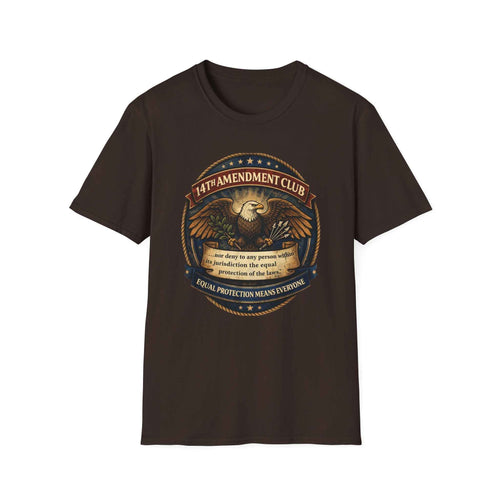
The phrase "make America think again" captures that shift. It is not about rejecting the country. It is about asking the people in power to reconsider what they are doing and why. That same spirit runs through the best immigration reform apparel. It does not just say "no." It says "try again, and do better." That distinction matters because it frames the debate as something that can be won through persuasion, not just confrontation.
Retail activism has grown because people want to put their money where their values are. When you buy a shirt from a company that donates a portion of its profits to immigrant rights groups, you are voting with your wallet. You are also funding the infrastructure that makes future protests possible. Coffee for change is another piece of that puzzle. A lot of activist brands now sell coffee as a way to fund their work and build community around shared values. It is a reminder that the movement is not just about the big moments. It is about the daily grind of showing up.
Navigating the Risks of Brand Activism
Brand activism carries its own risks. When a company ties its identity to a political statement, it invites scrutiny. Critics will accuse it of profiting from suffering. Supporters will demand consistency. The best brands in this space handle that tension by being transparent about where the money goes and what they stand for. They do not pretend to be saviors. They present themselves as tools that activists can use to amplify their own work.
Immigration reform apparel sits at the intersection of commerce and conscience. It is a product, but it is also a message. People who wear it are making a choice to be visible in a fight that often takes place behind closed doors. That visibility can be uncomfortable. It invites confrontation. But it also invites solidarity. The person who sees your shirt and nods is the person who might join you at the next rally.
The movement for democracy depends on ordinary people doing extraordinary things. Wearing a shirt is not the most radical act in the world, but it is a start. It breaks the silence. It says that this issue matters enough to claim it. And when enough people do that, the conversation changes. The Overton window shifts. What was once considered fringe becomes mainstream. That is how social change happens, one conversation, one shirt, one rally at a time.
If you are looking for a way to get involved in the fight for civil liberties, start with what you wear. Find a piece of immigration reform apparel that speaks to you. Wear it to the grocery store. Wear it to the protest. Wear it on the days when you feel like giving up. The message will reach someone who needs to hear it. And that is how you build the kind of mass movement that actually wins.